

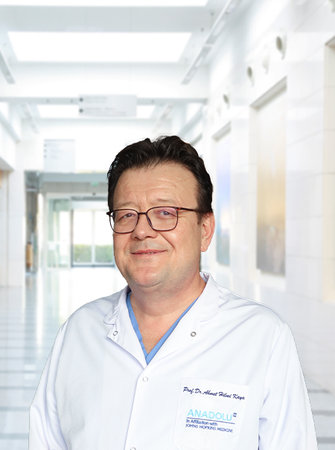
Ahmet Hilmi Kaya
Speciality
- Spinal Tumors
- Spinal Slippage
- Spinal Cord Tumors
- Spinal Stenosis
- Spinal Instrumentation
- Parkinson's and Movement Disorders Surgery (Deep Brain Stimulation)
- Essential Tremor Surgery
- Herniated Disc (Lumbar)
- Herniated Disc (Cervical)
- Stereotactic Biopsy
- Neuroanatomy
- Functional and Stereotactic Neurosurgery
- Cranial base surgery and brain tumors
- Vascular pathologies of the central nervous system
- Spinal surgery
Education
University of Istanbul, Cerrahpaşa Medical Faculty (English)
Department of Neurosurgery, Cerrahpaşa Medical Faculty, Istanbul University
Department of Neurosurgery, Faculty of Medicine, Ondokuz Mayıs University, Attained AssociateProfessorship
Attained Professorship from Gelişim University, İstanbul
Institutions Worked At
Watch videoMarmara University Faculty of Medicine, Department of Neurosurgery
Istanbul University Cerrahpasa Faculty of Medicine, Department of Neurosurgery
Private Erdem Hospital
Ondokuz Mayıs University, Faculty of Medicine, Department of Neurosurgery
Maastricht University, Cellular Neuroscience, Netherlands
Ondokuz Mayıs University, Faculty of Medicine, Department of Neurosurgery
Medicana International Hospital, Samsun Anadolu Medical Center, Gebze
Maastricht University, Cellular Neuroscience, Netherlands
Gelişim University School of Health Sciences
Anadolu Medical Center, Gebze
Private Gaziosmanpaşa Hospital Private Adatıp Hospital Yeditepe University Koşuyolu Hospital
Anadolu Medical Center, Gebze
Turkish Neurosurgical Society
Turkish Medical Association
A1. Ozyurt, E., T. Tanriverdi, A.H. Kaya, MY. Kaynar, T. Kacira ve G. Girisken, “Rapidly Progressing Sellar Chondromyxoid Fibroma: A Case Report and Review of the Literature”, Neurosurgery Q, 12, 307-311 (2002).
A2. Ozyurt, E., A.H. Kaya, T. Tanriverdi, S. Tuzgen, SA. Oguzoglu, MH. Hanefioglu ve C. Kuday, “New Classification for Insular Tumors and Surgical Results of 40 Patients”, Neurosurgery Q, 13, 138-148 (2003).
A3. Tuzgen, S., B. Canbaz, A.H. Kaya, G.Z. Sanus, C. Kuday, M. Memis ve B. Oz, “Experimental study of rapid versus slow sagittal sinus occlusion in dogs”, Neurol India, 51, 482-486 (2003).
A4. Kaya, A.H., T. Tanriverdi, M.Y. Kaynar, P. Erdincler ve M. Uzel, “An early and isolated origin of the angular artery from the middle cerebral artery”, Neurol India, 51, 425-427 ( 2003).
A5. Canbaz, B., T. Tanriverdi, A.H. Kaya ve S. Tuzgen, “Pott's puffy tumour: a rare clinical entity”, Lancet Infect Dis, 3, 721 (2003).
A6. Tuzgen, S., A.H. Kaya, D. Erdincler, S.A. Oguzoglu, O. Ulu ve S. Saip, “Two cases of neuro-Behcet's disease mimicking cerebral tumor”, Neurol India, 51, 376-378 (2003).
A7. Canbaz, B., T. Tanriverrdi, E. Ocal ve A.H. Kaya, “Endolymphatic Sac Tumor: A Rare Differential Diagnosis in Cerebellopontine Angle Lesions”, Neurosurgery Q, 14, 1-4 (2004).
A8. Tasdemiroglu, E., A.H. Kaya, S. Bek, C.B. Emir, A. Sengoz, O. Kilickesmez ve I. Mansuroglu, “Neurologic Complications of Cancer: Part 1: Central Nervous System Metastasis”, Neurosurgery Q, 14, 71-83 (2004).
A9. Erdincler, P., A.H. Kaya, A. Kafadar, B. Canbaz ve C. Kuday, “Bilateral peninsula-shaped linear craniectomy for mild degrees of craniosynostosis: indication, technique and long-term results”, J Craniomaxillofac Surg, 32, 64-70 (2004).
A10. Tasdemiroglu, E., A.H. Kaya, S. Bek, C.B. Emir, A. Sengoz, O. Kilickesmez ve I. Mansuroglu, “Neurologic Complications of Cancer: Part 2: Vascular, Infectious, Paraneoplastic, Neuromuscular, and Treatment-Related Complications”, Neurosurgery Q, 14, 133-153 (2004).
A11. Tasdemiroglu, E. ve A.H. Kaya, “Inappropriate (Ectopic) Hypothalamic and Pituitary Hormone-Secreting Syndromes”, Neurosurgery Q, 14, 161-167 (2004).
A12. Kaya, A.H., B. Sam, F. Celik ve U. Ture, “A quick-solidifying, coloured silicone mixture for injecting into brains for autopsy: technical report”, Neurosurg Rev, 29, 322-336 (2006).
A13. Senel, A., A. Dagcinar, A.H. Kaya ve E. Kuruoglu, “Localized Spontaneous Subarachnoid Hemorrhage as First Manifestation of Cerebral Venous Thrombosis”, Neurosurgery Quarterly, 16, 117-120 (2006).
A14. Dagcinar, A., A.H. Kaya, A. Senel ve F. Celik, “Sponge pieces as retractors in neurosurgical interventions”, Surg Neurol, 67, 493-495 (2007).
A15. Dagcinar, A., A.H. Kaya, M.E. Aydin, C. Kopuz, A. Senel, M.T. Demir, U. Corumlu, F. Celik ve B. Sam, “The Superior Cerebellar Artery: Anatomic Study With Review”, Neurosurgery Q, 17, 235-240 (2007).
A16. Senel, A., A.Hilmi.Kaya, E. Kuruoglu ve F. Celik, “Circumferential stabilization with ghost screwing after posterior resection of spinal metastases via transpedicular route”, Neurosurg Rev, 30, 131-137 (2007).
A17. Dagcinar, A., A.H. Kaya, H.A. Tasdemir, E.Kuruoglu, Z.Sabancilar ve Aydın Sav, “A fourth ventricular ganglioneurocytoma representing with cerebellar pilepsy: A case report and review of the literature”, Eur J Paediatr Neurol, 11, 257-260 (2007).
A18. Kaya, A.H., A. Dagcinar, I. Cebeci, A. Senel ve F. Celik, “A training model head of plaster of Paris for stereotactic localization”, Surg Neurol, 68, 544-546 (2007).
A19. Kaya, A.H., A. Dagcinar, A. Topal, A. Şenel ve O. Iyigun, “Sterereotactically guided craniotomy for transsulcal exposure of small subcortical lesions adjacent to eloquent areas”, Neurosurgery Q, 18, 130-132 (2008).
A20. Kaya, A.H., A. Dagcinar, F. Celik ve A. Senel, “Simple technique for removing broken pedicular screw with plain and servicable screwdriver”, European Spine Journal, 17, 1116-1118 (2008).
A21. Kaya, A.H., R. Vlamings, S. Tan, L.W. Lim, P.J. Magill, H.W.M. Steinbusch, V. Visser-Vandewalle, T. Sharp ve Y. Temel, “Increased electrical and metabolic activity in the dorsal raphe nucleus of Parkinsonian rats”, Brain Res, 1221, 93-7 (2008).
A22. Kaya, A.H., A. Ulus, Y. Bayri, A. Topal, S. Gun, B. Kandemir, A. Dagcinar, A. Senel ve O. Iyigun, “There are no estrogen and progesterone receptors in cerebral cavernomas A preliminary immunohistochemical study”, Surg Neurol, 72:263-5, (2009).
A23. Kaya, A.H., A. Dagcinar, M.O. Ulu, A. Topal, Y. Bayri, A. Ulus, C. Kopuz ve B. Sam, “The perforating branches of the P1 segment of the posterior cerebral artery: An anatomical study”, J Clin Neurosci, 17:80-4 (2010).
A24. Kopuz, Cem; Demir, Mehmet T.; Çorumlu, Ufuk; Aydin, Mennan E.; Korkmaz, Adnan; Çiftçioglu, Engin; A.H. Kaya. Morphologic Investigation of Ventriculus Terminalis in Newborns: Embryologic and Clinical Implications Neurosurgery Quarterly. 20(1):31-35, March 2010.
A.25. Kopuz C, Aydin ME, Kale A, Demir MT, Corumlu U, A.H. Kaya. The termination of superior sagittal sinus and drainage patterns of the lateral, occipital at confluens sinuum in newborns: clinical and embryological implications. Surg Radiol Anat. 2010 Feb 25. [Epub ahead of print] PubMed PMID: 20182724. A.26. Ulus A, AH Kaya, Bayri Y, Dagcinar A, Sataloglu H, Senel A. Poly-Axial Screw Removal. Cen Eur Neurosurg. 2010 Feb 4. [Epub ahead of print] PubMed PMID: 20135585. A.27.Aydin ME, Kopuz C, Demir MT, Corumlu U, AH Kaya. Localization of pterion in neonatal cadavers: a morphometric study. Surg Radiol Anat. 2010 Jan 3. [Epub ahead of print] PubMed PMID: 20047050.
A.28. Jahanshahi A, Vlamings R, Kaya AH, Lim LW, Janssen ML, Tan S, Visser-Vandewalle V, Steinbusch HW, Temel Y. Hyperdopaminergic status in experimental Huntington disease. J Neuropathol Exp Neurol. 2010 Sep;69(9):910-7.
A.29. Aydın ME, Kaya AH, Kopuz C, Demir MT, Corumlu U, Dagcinar A. Bilateral origin of superior cerebellar arteries from the posterior cerebral arteries, and clues to its embryologic basis. Anat Cell Biol. 2011 Jun;44(2):164-7. Epub 2011 Jun 30.
A.30. Türe U, Harput MV, Kaya AH, Baimedi P, Firat Z, Türe H, Bingöl CA. The paramedian supracerebellar-transtentorial approach to the entire length of the mediobasal temporal region: an anatomical and clinical study. Laboratory investigation. J Neurosurg. 2012 Apr;116(4):773-91. Epub 2012 Jan 20.
A.31. Ulus A, Kuruoglu E, Ozdemir SM, Yapici O, Sensoy G, Yarar E, Kaya AH, Senel A,Dagcinar A. CSF hydrothorax: neither migration of peritoneal catheter into the chest nor ascites. Case report and review of the literature. Childs Nerv Syst. 2012 Nov;28(11):1843-8.
A.32. Ulus A, Kaya AH, Sabancılar Z, Dağcılar A, Şenel A. Laminectome: A New Drilling Kerrison Rongeur for Partial Hemilaminectomy. Neurosurgery Quarterly. 2012;22(4):226–227.
A.33. Kaya AH, Erdoğan H, Taşdemiroğlu E. Searching Evidence of Stroke in Animal Models: A Review of Discrepancies. Turkish Neurosurgery. 2017;27(2):167–173.
DOI: 10.5137/1019-5149.JTN.15373-15.2
A.34. Erdoğan H, Kaya AH, Bilal K, Aziz Y, Erol T. Atypical Localization of a Grossly Calcified Dysembryoplastic Neuroepithelial Tumor (DNET): A Case Report. Austin Journal of Neural & Neuroscience. 2017;2(1):1016.
A.35. Erdoğan H, Antar V, Kaya AH, Fırat L, Kubilay T, et al. Animal Models of Autism Spectrum Disorder. Journal of Neurology & Stroke. 2017;6(4):00209.
DOI: 10.15406/jnsk.2017.06.00209
A.36. Erdoğan H, Altun A, Kuruoğlu E, Kaya AH, Dağcılar A. Difficulties of Distal Catheter Insertion of Ventriculoatrial Shunting in Infants and Young Children. Turkish Neurosurgery. 2017.
DOI: 10.5137/1019-5149.JTN.21304-17.2
A.37. Bakirezer SD, Yaltırık CK, Kaya AH, Yılmaz SG, Özdoğan S, Billur D, İşbir T. Evaluation of Glutathione Reductase and Malondialdehyde Levels in Patients with Lumbar Disc Degeneration Disease. In Vivo. 2019;33(3):811–814.
A.38. Ulus A, Kaya AH, Güvenç D, Aksoy A, Şenel A. The Effect of Early Myelotomy on Glutamate Concentrations in a Spinal Cord Injury Rat Model. Turkish Neurosurgery. 2022;32(6):1017–1022.
A.39. Ulus A, Kaya AH, Şenel A. Iatrogenic Leg Length Inequality May Cause Low Back Pain Due to Scoliosis. Journal of Experimental and Clinical Medicine. 2022;39(2):516–520.
B. Presentations (international)
B1. Ozyurt, E., T. Tanrıverdi, A.H. Kaya, C. Ozkara, N. Yeni, N. Karaagac, A. Dervent, E. Eskazan ve C. Kuday, “Surgical outcome of the epileptic patients evaluated noninvasively with tumoral and nontumoral mesial temporal lesions”, 7th Mediterranean Epilepsy Conference, 59, Athens, 2001.
B2. Ozyurt, E., S.A. Oguzoglu, A.H. Kaya, T. Tanrıverdi ve C. Kuday, “New classification of insular tumors and surgical results of 40 patients”, International Neurosurgical Conference, 2, Shanghai, 2002.
B3. Sanus, G.Z., A.H. Kaya, T. Tanrıverdi, T. Kacire, Z. Akar, E. Ozyurt ve C. Kuday, “Surgical results of the petroclival meningiomas”, 4th International Congress on Cerebral Venous System and 4th International Congress on The Meningiomas Combined with Annual Meeting of Turkish Neurosurgical Society, 68, Istanbul, 2002.
B4. Kaya, A.H., T. Tanriverdi, T. Kacira, M.Y. Kaynar, E. Ozyurt, N. Ciplak ve C. Kuday, “Surgical results of the foramen magnum meningiomas”,. 4th International Congress on Cerebral Venous System and 4th International Congress on The Meningiomas Combined with Annual Meeting of Turkish Neurosurgical Society, 68, Istanbul, 2002.
B5. Tanrıverdi, T., A.H. Kaya, T. Kacira, S.A. Oguzoglu, Z. Akar, E. Ozyurt ve C. Kuday, “Surgical results of the sphenoid wing meningiomas”, 4th International Congress on Cerebral Venous System and 4th International Congress on The Meningiomas Combined with Annual Meeting of Turkish Neurosurgical Society, 54, Istanbul, 2002.
B6. Kafadar, A., M.Y. Kaynar, T. Tanriverdi, A.H. Kaya, E. Ozyurt, ve C. Kuday, “Surgical results of parasagittal and falx meningiomas”, 4th International Congress on Cerebral Venous System and 4th International Congress on The Meningiomas Combined with Annual Meeting of Turkish Neurosurgical Society, 57, Istanbul, 2002.
B7. Ozyurt, E., S.A. Oguzoglu, M.O. Ulu, A.H. Kaya, T. Tanrıverdi, M. Uzan ve C. Kuday, “Limbic and paralimbic tumors. Surgical results and retrospective analysis of 187 patients”, 3rd Shanghai International Conference of Neurosurgery, 3rd Meeting of the Asian Society for Neuro-Oncology, 7, Shanghai, 2003.
B8. Kopuz, C., M.E. Aydin, A. Kale, M.T. Demir, U. Corumlu ve A.H. Kaya, “The common variations of the dural sinuses at confluens sinuum in newborns”, 1st. Congress of Serbian anatomical Society with International Participation, 34, Novi Sad, 2006.
B9. Aydin, M.E., C. Kopuz, M.T. Demir, U. Corumlu ve A.H. Kaya, “The localization of the pterion in neonatal cadevers: A morphometric study”, 1st. Congress of Serbian anatomical Society with International Participation, 164, Novi Sad, 2006.
B10. Kopuz, C., M.E. Aydin, U. Corumlu, M.T. Demir ve A.H. Kaya, “The anatomy of accessory atlantoaxial ligament in newborns”, 1st. Congress of Serbian anatomical Society with International Participation, 125, Novi Sad, 2006.
B11. Ture, U., A.H. Kaya, G. Karlikaya, Z. Fırat, H. Ture, C.A. Bingol ve Ilhami Kovanlıkaya, “The value of fiber tractography with the 3-Tesla MRI system for brainstem surgery”, AANS Annual Meeting, J Neurosurg Vol 108, p A852, Chicagho, 2008.
B12. Kaya A.H., R. Vlamings, S. Tan, L.W. Lim, P. Magill, H.W. Steinbusch, V. Visser-Wandewalle, T. Sharp, Y. Temel, “Increased electrical and metabolic activity in the dorsal raphe nucleus of Parkinsonian rats”, 18th. Congress of the European Society for Stereotactic and Functional Neurosurgery, Acta Neurochir (Wien) Vol 150, p 958, Rimini, 2008.
B13. Cemile Ceylan, Andaç Hamamcı, Nadir Küçük, Kutlay Karaman, Ahmet Hilmi Kaya, Gozde Onal, Kayıhan Engin: Robotic stereotactic radiosurgery for acustic neuromas: Prediction of tumor control with definition of necrotic area inside tumor volume.11 th meeting of Asian Society ofNeuro-Oncology, 2014, İstanbul
B14. Cemile Ceylan, Ahmet Hilmi Kaya, Hande Baş Ayata, Ayhan K1h9, Timur Ugur, Metin Gi.iden, Kayıhan Engin: Stereotactic radiosurgery with cyberknife for intracranial meningiomas. 11 th meeting of Asian Society of Neuro-Oncology, 2014, istanbul
C. Book Chapters
C1. Ture, U., A.H. Kaya, C.A. Bingöl, “Transsylvian Selective Amygdalohippocampectomy”, Pediatric Epilepsy Surgery: Preoperative Assessment and Surgical Treatment, eds. O. Cataltepe and G. Jallo, Thieme Publisher, 2010u
C2. Ture, U., A.H. Kaya, “Craniovervical junction surgical anatomy”, Pathology and Surgery around the Vertebral Artery, eds. B. George, m. Bruneau and R.F. Spetzler, Springer, 2012
C3. Ture U, A.H. Kaya, ‘’Principles for managing cavernous malformations in eloquent locations.’’, Cavernous Malformations of the Nervous System ed. Daniele Rigamonti. Cambridge University Press, 2011.
C4. Türe U, Kaya AH: The combined approach for craniopharyngiomas. (in) Controversies in Neurosurgery II, (ed): Al-Mefty 0. Thieme, New York, 2013: 157-163
D. Publications (national)
D1. Erkol, G., E. Yılmaz, A.H. Kaya, M.A. Akalın, M.Y. Kaynar, A. Altıntaş, E. Erdoğan, Ö.Ünsal, C. Kuday ve A. Siva, “Association of human leuckocyte antigens and neuroepithelial tumors in Turkish population: Preliminary results”, Turk J Immunol, 5, 1-4 (2000).
D2. Özyurt, E., Ş.A. Oğuzoğlu, A.H. Kaya, T. Tanrıverdi ve T. Kaçıra, “Solitary Langerhans’ Cell Histiocytosis of the occipital lobe: A case report”, Turkish Neurosurgery, 12, 102-106 (2002).
D3. Tüzgen, S., M.Y. Kaynar, T. Tanrıverdi, A.H. Kaya ve E. Özyurt, “Multifocal medulloblastoma: A short report”, Turkish Neurosurgery, 12, 113-115 (2002).
D4. Özyurt, E., Ş.A. Oğuzoğlu, A.H. Kaya, T. Tanrıverdi, R. Enar ve D. Uçak, “Medikal tedaviye dirençli esansiyel hipertansiyonda cerrahi tedavi: İki vakanın sunumu”, Anadolu Kardiyoloji Dergisi, 2, 40-44 (2002).
D5. Tüzgen, S., A.H. Kaya, G.Z. Sanus ve Z. Akar, “Acute spontaneous spinal epidural hematoma”, Journal of Neurological Sciences (Turkish), 19, 4 (2002).
D6. Cesur, B., A.H. Kaya, Y. Bayri, A. Ulus, A. Dağçınar ve A. Şenel, “Çocukluk çağı intrakranial anevrizmaları; olgu sunumu ve literatürün gözden geçirilmesi”, Türk Nöroşirürji Dergisi, 18, 128-133 (2008).
D7. Y. Bayri, A.K. Ulaş, A. Ulus, A.H. Kaya, A. Dağçınar Iatrogenic chronic calcified/ossified epidural hematoma: Case report, Sinir Sistemi Cerrahisi Derg 2(2):91-94, 2009.
D.8. A.H. Kaya, Ture U. Sfenoid Kanat Meningiomları. Türk Nöroşirürji Dergisi 21(2): 131-136, 2011
D9. A.H. Kaya, Dağçınar A. Surgical Approaches to Posterior Fossa Epidermoid Tumors. Turkish Neurosurgery Journal 27(1): 82-85, 2017
E. Presentations (national)
E1. Tüzgen, S., Z. Sanus, B. Canbaz, A.H. Kaya, Z. Akar and C. Kuday, “Adult hydrocephalus”, Turkish Neurosurgical Society 12th Scientific Congress, 247, Antalya, 1998.
E2. Sanus, Z., M. Uzan, A.H. Kaya, B. Canbaz, E. Özyurt and C. Kuday, “Treatment selection and outcomes in delayed post-traumatic facial paralysis”, Turkish Neurosurgical Society 12th Scientific Congress, 247–248, Antalya, 1998.
E3. Kaya, A.H., İ. Alver, P. Erdinçler, T. Tanrıverdi, M.Y. Kaynar and N. Çıplak, “Posterior fossa tumors in the pediatric age group”, Turkish Neurosurgical Society 14th Scientific Congress, 55, Antalya, 2000.
E4. Kaya, A.H., R. Dashti, M.Y. Kaynar, B. Canbaz, E. Özyurt and C. Kuday, “Surgical outcomes in intracranial cavernous malformations”, Turkish Neurosurgical Society 14th Scientific Congress, 127–128, Antalya, 2000.
E5. Özyurt, E., A.H. Kaya, T. Tanrıverdi, M. Uzan, S. Tüzgen and C. Kuday, “Surgical outcomes in insular tumors”, Turkish Neurosurgical Society 15th Scientific Congress, 162–163, Antalya, 2001.
E6. Özyurt, E., T. Tanrıverdi, A.H. Kaya, M. Uzan, S. Tüzgen and C. Kuday, “Microvascular decompression in a patient with treatment-resistant hypertension”, Turkish Neurosurgical Society 15th Scientific Congress, Antalya, 2001.
E7. Özyurt, E., A.H. Kaya, T. Tanrıverdi, Ç. Özkara, N. Yeni, N. Karaağaç, A. Dervent, E. Eşkazan and C. Kuday, “Surgical outcomes of epileptic patients with tumoral and non-tumoral mesial temporal lesions evaluated by non-invasive methods”, 37th National Neurology Congress, 102, Antalya, 2001.
E8. Kaya, A.H., P. Erdinçler, H. Ak, N. Çıplak and C. Kuday, “Bilateral peninsula-shaped craniectomy: method and applications”, Turkish Neurosurgical Society 16th Scientific Congress, 217, Istanbul, 2002.
E9. Tüzgen, S., A.H. Kaya, H. Hanımoğlu, B. Canbaz, B. Öz, E. Özyurt and C. Kuday, “Behavioral patterns in atypical meningiomas”, Turkish Neurosurgical Society 16th Scientific Congress, 182, Istanbul, 2002.
E10. Kaya, A.H., B. Sam, E. Özyurt and C. Kuday, “Examination of cerebral arterial anatomy by silicone injection in cadavers: technical report”, Turkish Neurosurgical Society 18th Scientific Congress, 97, Antalya, 2004.
E11. Şenel, A., A. Dağçınar, A.H. Kaya, E. Kuruoğlu, A. Topal and F. Çelik, “Craniovertebral junction anomaly due to acromesomelic skeletal dysplasia: case presentation”, Turkish Neurosurgical Society 20th Scientific Congress, 100–101, Antalya, 2006.
E12. Dağçınar, A., A.H. Kaya, A.H. Taşdemir, E. Kuruoğlu, Z. Sabancılar, A. Şenel and F. Çelik, “A case of fourth ventricle-localized gangliocytoma causing cerebellar epilepsy: case presentation”, Turkish Neurosurgical Society 20th Scientific Congress, 100, Antalya, 2006.
E13. Dağçınar, A., A.H. Kaya, A. Şenel, E. Kuruoğlu and F. Çelik, “Development of SCIWORA at the craniovertebral junction in a Chiari I case: case presentation”, Turkish Neurosurgical Society 20th Scientific Congress, 182, Antalya, 2006.
E14. Kaya, A.H., M.E. Aydın, C. Kopuz, A. Dağçınar, A. Şenel, M. Demir, E. Kuruoğlu, U. Çorumlu, A. Topal and F. Çelik, “Anatomy of the anterior cerebral artery”, Turkish Neurosurgical Society 20th Scientific Congress, 162, Antalya, 2006.
E15. Kaya, A.H., C. Kopuz, A. Dağçınar, M.E. Aydın, A. Şenel, M. Demir, E. Kuruoğlu, U. Çorumlu, Z. Sabancılar and F. Çelik, “Distal anatomy of the middle cerebral artery”, Turkish Neurosurgical Society 20th Scientific Congress, 162, Antalya, 2006.
E16. Şenel, A., A.H. Kaya, E. Kuruoğlu and F. Çelik, “Stabilization with ghost screw fixation in spinal metastases”, Turkish Neurosurgical Society 20th Scientific Congress, 54–55, Antalya, 2006.
E17. Şenel, A., A. Dağçınar, A.H. Kaya, E. Kuruoğlu, A. Topal and F. Çelik, “The role of ligamentotaxis in thoracolumbar trauma”, Turkish Neurosurgical Society 20th Scientific Congress, 146, Antalya, 2006.
E18. Şenel, A., A. Dağçınar, A.H. Kaya, E. Kuruoğlu, Z. Sabancılar and F. Çelik, “Application of distractible cages in cervical vertebral pathologies”, Turkish Neurosurgical Society 20th Scientific Congress, 146, Antalya, 2006.
E19. Kaya, A.H., A. Dağçınar, İ. Cebeci, A. Şenel and F. Çelik, “Plaster head training model for stereotactic localization”, Turkish Neurosurgical Society 21st Scientific Congress, 79, Antalya, 2007.
E20. Kaya, A.H., A. Dağçınar, A. Topal, A. Şenel and F. Çelik, “Transsulcal approach to subcortically located lesions via craniotomy under stereotactic guidance”, Turkish Neurosurgical Society 21st Scientific Congress, 78, Antalya, 2007.
E21. Dağçınar, A., A.H. Kaya, M.E. Aydın, C. Kopuz, A. Şenel, M.T. Demir, U. Çorumlu and B. Sam, “Superior cerebellar artery: an anatomical study”, Turkish Neurosurgical Society 21st Scientific Congress, 49, Antalya, 2007.
E22. Dağçınar, A., A.H. Kaya, A. Şenel and F. Çelik, “Use of sponge fragments as retractors in neurosurgical operations”, Turkish Neurosurgical Society 21st Scientific Congress, 169, Antalya, 2007.
E23. Kaya, A.H., A. Ulus, A. Dağçınar, F. Çelik and Alparslan Şenel, “Laminatom: a Kerrison drill designed for laminotomy”, Turkish Neurosurgical Society 22nd Scientific Congress, 73, Antalya, 2008.
E24. Kaya, A.H., A. Dağçınar, F. Çelik and A. Şenel, “A practical screw extractor for removal of broken pedicle screws”, Turkish Neurosurgical Society 22nd Scientific Congress, 73–74, Antalya, 2008.
E25. Kaya, A.H., A. Ulus, Y. Bayri, A. Topal, S. Gün, B. Kandemir, A. Dağçınar, A. Şenel and Ö. İyigün, “Absence of estrogen and progesterone receptors in cerebral cavernomas: a preliminary immunohistochemical study”, Turkish Neurosurgical Society 22nd Scientific Congress, 59, Antalya, 2008.
E26. Kaya, A.H., R. Vlamings, S. Tan, L.W. Lim, P. Magill, H.W. Steinbusch, V. Visser-Wandewalle, T. Sharp, Y. Temel, “Increased electrical and metabolic activity in the dorsal raphe nucleus of Parkinsonian rats”, Turkish Neurosurgical Society 22nd Scientific Congress, 32, Antalya, 2008.
E27. Cesur, B., A.H. Kaya, Y. Bayri, A. Ulus, A. Dağçınar and A. Şenel, “Intracranial aneurysms in childhood: case presentation and review of the literature”, Turkish Neurosurgical Society 22nd Scientific Congress, 85, Antalya, 2008.
E28. Bayri, Y., A.K. Ulaş, A.H. Kaya, A. Ulus, A. Dağçınar and F. Çelik, “Calcification of chronic epidural hematoma developing after surgery for a giant intracranial mass: case presentation”, Turkish Neurosurgical Society 22nd Scientific Congress, 85–86, Antalya, 2008.
E29. Ulus, A., A.H. Kaya, Y. Bayri, A. Dağçınar, F. Çelik and A. Şenel, “Incorrect use of interspinous devices and complications”, Turkish Neurosurgical Society 22nd Scientific Congress, 94, Antalya, 2008.
E.30. Kaya AH, Dağçınar A, Ulu MO, Topal A, Bayri Y, Ulus A, Kopuz C, Şam B, “Perforating branches of the P1 segment of the posterior cerebral artery: a neuroanatomical study”, Turkish Neurosurgical Society 23rd Scientific Congress, Cyprus, April 2009.
E.31. Topal, A., Z. Sabancılar, A.H. Kaya, A. Dağçınar, S. Kaplan, C. Marangoz, M. Ayyıldız, B. Kandemir, Y. Temel and R. Vlamings, “Changes in brain metabolic activity following bilateral subthalamic nucleotomy in rats with experimentally induced Parkinson’s disease”, Turkish Neurosurgical Society 23rd Scientific Congress, 29–30, Girne, 2009.
E.32. Sabancılar, Z., A. Topal, A. Dağçınar, A.H. Kaya, S. Kaplan, C. Marangoz, M. Ayyıldız, B. Kandemir, Y. Temel and R. Vlamings, “Changes in brain metabolic activity following bilateral pallidotomy (entopeduncular nucleotomy) in rats with experimentally induced Parkinson’s disease”, Turkish Neurosurgical Society 23rd Scientific Congress, 31, Girne, 2009.
E.33. Ulus, A., A.H. Kaya, H. Sataloğlu, A.K. Ulaş, Y. Ulus, K. Göl and Ö. İyigün, “Anterior approach to the upper thoracic spinal column via simple partial upper sternotomy: case presentation”, Turkish Neurosurgical Society 23rd Scientific Congress, 97, Girne, 2009.
E.34. Ulus, A., A.H. Kaya, H. Sataloğlu, B. Cesur, T. Yılmaz, A. Sav and Ö. İyigün, “An extremely rare tumor, chordoid glioma of the third ventricle: case presentation”, Turkish Neurosurgical Society 23rd Scientific Congress, 49, Girne, 2009.
E.35. Tayfur V, A. Ulus, A.H. Kaya, A. Dağçınar. “Approach to the skull base via open rhinoplasty”. 31st National Congress of Turkish Plastic, Reconstructive and Aesthetic Surgery, Adana, 2009.
E.36. Topal A, A.H. Kaya, Cebeci Hİ, Hamzaoğlu V, Akkurt A, Şahin H. “Placement of the battery into the calvarium in deep brain stimulation”. Turkish Neurosurgical Society 26th Scientific Congress, 122, Antalya, 2012.
E.37. Cebeci Hİ, A.H. Kaya, Topal A, Hamzaoğlu V, Akkurt A, Şahin H. “Transient loss of libido in a patient who underwent deep brain stimulation of the globus pallidus interna for dystonia”. Turkish Neurosurgical Society 26th Scientific Congress, 122, Antalya, 2012.
E.38. Adnana Dağcılar, Ercan Genç, Meltem Ceylan, Ümit Belet, Tevfik Sunter, Yaşar Bayri, Aykan Ulus, Ahmet Hilmi Kaya: Investigation of developmental differences of the posterior arterial circulation and their clinical correlations in Chiari Type II malformation. Turkish Neurosurgical Society 27th Scientific Congress, 2013, Antalya.
E.39. Kumsal Bihter Kontaytekin, Mehmet Volkan Harput, Cumhur Kaan Yaltırık, Hatice Hire, Ahmet Hilmi Kaya, Başar Sarıkaya, Uğur Hire. Surgical positions compatible with intraoperative magnetic resonance imaging and the use of pinned head holders. Turkish Neurosurgical Society 33rd Scientific Congress, 11–14 April 2019, Antalya.
E.40. Ezgi Aytaç, Şüheda Çelebi, Neslihan Uztüre, Cumhur Kaan Yaltırık, Ferdi Menda, Ahmet Hilmi Kaya, Hatice Türe. Investigation of the effectiveness of using T-shaped hollow face cushions and adhesive mica protective goggles in the prone position in spinal surgery for preventing pressure ulcer formation. Turkish Neurosurgical Society 33rd Scientific Congress, 11–14 April 2019, Antalya.
Awards, Congress and Course Participation Certificates, and International Training Certificates
- 3rd International Bakırköy Days, 6–8 November 1996, Istanbul
- Turkish Neurosurgical Society 14th Scientific Congress, 17–21 May 2000, Antalya
- Turkish Neurosurgical Society Training Course, Tumors, 13–18 March 2001, Antalya
- EANS Research Committee Course, “Methodology of Research and Publication”, 28–31 March 2001, Antalya
- Turkish Neurosurgical Society 18th Scientific Congress, 22–26 May 2004, Antalya
- Ondokuz Mayıs University, Faculty of Medicine, “13th Problem-Based Learning Course”, 24–28 October 2005, Samsun
- 3rd International Symposium on Microneurosurgical Anatomy, 5–8 November 2006, Antalya
- Turkish Neurosurgical Society Spinal and Peripheral Nerve Surgery Education and Training Group, “Autumn Symposium on Spinal and Peripheral Nerve Injuries”, 2–5 November 2006, Antalya
- Turkish Neurosurgical Society 21st Scientific Congress, 20–24 April 2007, Antalya
- Acıbadem–Harvard Medical Days, “Movement Disorders”, 22 October 2007, Istanbul
- Turkish Neurosurgical Society Spinal and Peripheral Nerve Surgery Education and Training Group, “Spinal and Spinal Cord Tumors”, 18–21 October 2007, Antalya
- “Live Neurovascular Microsurgery Course”, Department of Neurosurgery, Cerrahpaşa Medical Faculty, 29–31 October 2007, Istanbul
- Turkish Neurosurgical Society Stereotactic and Functional Neurosurgery Education and Training Group, “Innovations in Functional Neurosurgery”, 23 November 2007, Adana
- Ondokuz Mayıs University, Animal Experiments and Local Ethics Committee, Experimental Animal Use Certificate, Certificate No: 0087, 06.07.2007, Samsun
- “Follow-up on Neuro-Morphological and Surgery Knowledge”, Pisa University, Department of Human Anatomy and Applied Biology, 16–17 November 2007, Pisa
- Turkish Neurosurgical Society Basic Neurosurgery and Training Course, “Head Trauma, Pain and Functional Neurosurgery”, 11–14 March 2008, Izmir
- Turkish Neurosurgical Society 22nd Scientific Congress, 18–22 April 2008, Antalya
- Turkish Neurosurgical Society 23rd Scientific Congress, 2009, Girne
- OSCE preparation training, Turkish Pharmacology Society, 6–8 January 2011, Samsun
- Turkish Neurosurgical Society 25th Scientific Congress, 2011, Antalya
- Turkish Neurosurgical Society Neuro-Oncological and Neurovascular Surgery Education and Training Groups Joint Symposium, Participation, 28–29 December 2013, Istanbul
- Turkish Neurosurgical Society Neuro-Oncological and Neurovascular Surgery Education and Training Groups Joint Symposium, Contribution, 28–29 December 2013, Istanbul
- Turkish Neurosurgical Society 27th Scientific Congress, 2013, Antalya
- 5th Istanbul Microneurosurgery Course, Part 2: Hands-on White Matter Dissection and Live Surgery in 3D, 22–28 June 2014, Istanbul
- International DBS Surgery and Microelectrode Recording Cadaver Course, contribution, 6–7 February 2015, Istanbul
- Basic Life Support Training, 29 December 2015, Istanbul
- Turkish Neurosurgical Society TUMOG, Neuro-Oncological Surgery Education and Training Group Symposium, Sellar and Parasellar Region Lesions, 16–17 December 2016, Istanbul
- 8th Istanbul Microneurosurgery Course, Part 1: Hands-on Microvascular Anastomosis, 7–10 June 2017, Istanbul
- 8th Istanbul Microneurosurgery Course, Part 2: Hands-on White Matter Dissection and Live Surgery, 11–16 June 2017, Istanbul
- Health Law Practices Training, 19 July 2017, Istanbul
- Turkish Neurosurgical Society 33rd Scientific Congress, 2019, Antalya
- UBE Turkish Society International Spine Endoscopy 2nd Meeting, 5–7 September 2019, Bursa
- Yeditepe University 1st Pituitary Day, Craniopharyngiomas, 12 October 2019, Istanbul
- University of Maastricht, Department of Cellular Neuroscience, 2007, Netherlands
CITATIONS
Web of Science–based: Total of 262 citations
Google Scholar–based: Total of 418 citations


Featured Cancer Articles
- 6 Nutrition Tips for Those Who Fast
- What is Disease X (Virus X)?
- How Does Cancer Form?
- What is an Ovarian Cyst?
- What is Cervical Cancer?
- What Are the Symptoms and Treatment Methods of Testicular Cancer?
- Symptoms, Diagnosis, and Treatment Process of Bladder Cancer
- Liver Cancer
- What is Stomach Cancer? What are Its Symptoms and Treatment?
- Thyroid: What is it, Symptoms, Diagnosis, and Treatment
